
Making Bias Visible: How Splitting Demand and Contribution Reduces Gender Pay Gaps
- Jonny Turner
- Oct 14, 2025
- 2 min read

Updated: Nov 3, 2025
Understanding the Challenge of Equal Pay
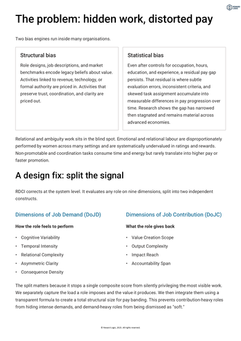
Most equal pay job evaluations and pay processes absorb cultural assumptions about what counts as "real work." This often leads to significant disparities in how different types of work are valued. Tasks that are relational or performed in ambiguous contexts are frequently overlooked. These responsibilities are commonly shared across various roles but disproportionately affect women. Consequently, they correlate poorly with pay, leading to inequitable compensation structures.
The Role of Reward Logic's Demand–Contribution Index
Reward Logic's Role Demand–Contribution Index (RDCI) offers a solution. This innovative tool separates how a role demands effort from how it contributes value. By scoring both aspects with auditable criteria, the RDCI brings the "invisible" load into view. This visibility is crucial for addressing biases that have historically skewed pay evaluations.
Cleaner Data and Fewer Biased Proxies
The RDCI results in cleaner data, which is essential for making informed decisions about compensation. By eliminating biased proxies, it allows for more defensible pay outcomes. This is particularly important for businesses and organisations that are committed to fair pay and compliance.
The Importance of Transparency in Pay Structures
Transparency is a key component in creating fair pay structures. When employees understand how their roles are evaluated and compensated, it fosters trust and engagement. The RDCI promotes this transparency by providing clear criteria for assessing both demand and contribution.
Addressing the Gender Pay Gap
One of the primary goals of implementing the RDCI is to actively work towards closing the gender pay gap. By making the contributions of all employees visible, organisations can ensure that everyone is compensated fairly. This is not just a moral imperative; it is also a business necessity. Companies that prioritise equitable pay are more likely to attract and retain top talent.
Conclusion
In conclusion, the Role Demand–Contribution Index is a powerful tool for organisations seeking to eliminate bias in job evaluations. By separating effort from value and making the invisible visible, the RDCI helps create fair and transparent pay structures. This ultimately prevents disputes and actively works to close pay gaps across all industries.
For a deeper understanding of this topic, I encourage you to explore the detailed insights in the Making Bias Visible: How Splitting Demand and Contribution Reduces Gender Pay Gaps document.





Comments